


Chilean study on red sea urchins shows the effects of light pollution on the oceans

Posteado
Cielos Chile
schedule Tuesday 02 de September
A study by the Center for Arid Zone Studies (CEAZA) conducted in northern Chile shows that nighttime lighting in coastal areas affects the activity and metabolism of red sea urchins, which can have a knock-on effect on other benthic species and cause imbalances in their ecosystem.
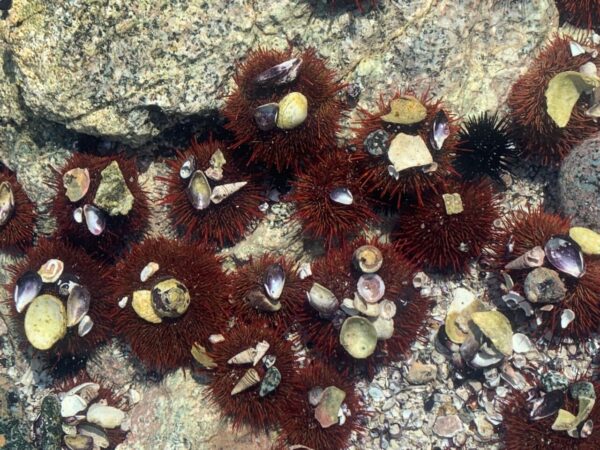
The red sea urchin (Loxechinus albus) plays a key ecological role along the entire coast of South America. A new study, conducted by Chilean researchers, demonstrated the effects of artificial night lighting on this species, which could have cascading impacts on coastal marine ecosystems.
The research, published in the journal Marine Pollution Bulletin, was conducted by the Center for Arid Zone Studies (CEAZA) on the northern coast of Chile and under controlled conditions in the laboratory of the Universidad Católica del Norte in Coquimbo. The experiment demonstrated that artificial light commonly used in coastal cities, ports, and waterfronts can affect the behavior and metabolism of this sea urchin.
The results revealed that under artificial night light, the sea urchins studied ate less, moved faster, sought to move to dark areas, and expended more energy on maintaining themselves and moving than on growing, compared to sea urchins that remained in darkness.
These conclusions, say the authors, are similar to those reported by two studies conducted in Italy and published in 2014 on the Mediterranean sea urchin (Paracentrotus lividus), and raise a red flag in coastal environments where artificial lighting is constantly expanding due to urban development.
Effects of artificial lighting on the marine ecosystem
“When sea urchins change the way they move or feed, they no longer fulfill their regulatory role as effectively. If they decrease their activity, they can allow algae to grow excessively. Conversely, if they cluster in darker areas to avoid light, they could consume vegetation disproportionately, leaving areas of the substrate bare,” explains Dr. Patricio Manríquez, a researcher at CEAZA and lead author of the study.
In both cases, he adds, the habitat changes and many other species that depend on this species, including its predators, may be affected, which could lead to spatial imbalances that alter the natural distribution of benthic fauna, as well as increase pressure on available resources.
“What may seem like a minor change in the behavior of a single species has the potential to trigger a series of broader impacts, affecting the health and stability of coastal marine ecosystems,” warns the researcher.
He adds that “if the expansion of artificial light at night (ALAN) in coastal areas continues without management or mitigation measures, it could have negative impacts on shallow-water populations that, in the long term, affect the productivity and sustainability of fisheries.”
Given the above, the authors issue a preventive call to implement actions that prevent the growing presence of lighting in coastal areas from translating into economic and environmental damage in the future.
“Applying the precautionary principle in the management and regulation of coastal artificial lighting is essential to protect biodiversity and ensure the sustainability of our coastal marine resources,” the researcher emphasizes.

Credits: Priyanka Thakran en Unsplash

Subscribe to our newsletter
Receive relevant information about the skies of Chile every month