


Mejillones commits to protecting dark skies as part of its environmental work
Posteado
Cielos Chile
schedule Tuesday 02 de September
Due to its proximity to astronomical observatories, Mejillones is one of 29 municipalities regulated by lighting standards. Today, it is taking concrete steps to incorporate the protection of the night sky into its environmental management.
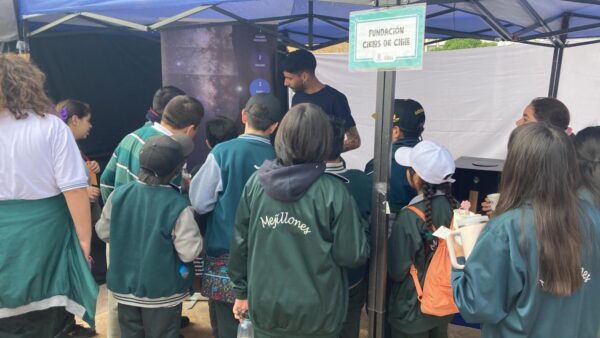
On June 12, the Cielos de Chile Foundation took part in the environmental fair organized by the Municipality of Mejillones to mark World Environment Day. The activity focused on environmental education for children and young people and brought together various organizations with information stands on recycling, marine biodiversity, electromobility, and light pollution.
For Fernando Campos, the municipality’s director of Environment, Sanitation, and Beautification, the fair was an opportunity to broaden the community’s environmental focus and integrate new topics. “The idea was for students to learn a little bit about each area: PET recycling, wood, composting, local wildlife, and also the impact of artificial light on the environment, with the help of the Cielos de Chile Foundation,” he explained.
Although this was the first collaboration between the Foundation and the municipality, Fernando envisions a long-term joint effort. “We were interested in adding the expert perspective of the Cielos de Chile Foundation so that the community understands that light also pollutes. These types of activities help us raise awareness of this problem,” he added.
Daniela González, executive director of the Cielos de Chile Foundation, appreciated the municipality’s interest in including this issue in its environmental agenda: “We are happy to see that Mejillones is opening spaces for conversation about light pollution and its impact. These instances allow us to bring the issue closer to the local community and reinforce that the night sky also needs protection. We believe this is just the beginning of a very promising collaborative effort.”
The reality of the municipality
In Mejillones, the effects are already being felt on local biodiversity. One of the most notable cases for the municipality’s residents is that of the sea swallow, a protected species that arrives in the coastal area and becomes disoriented by the city’s white lights. “There are times of the year when we see them being hit by the lights, and that worries the community,” said Fernando Campos. This bird, like other marine and coastal species, is affected by artificial light that alters its orientation.
Although it is not easy to see the starry sky from the urban center of Mejillones, in more remote areas, high-quality skies are still preserved. This has sparked the interest of some residents in developing activities related to astro-tourism. “They are more enthusiastic than anything else, but there is potential. The north is good for that,” said Fernando Campos.
New lighting regulations
Under the new lighting regulations, Mejillones is classified as a nearby commune due to its proximity to the Paranal astronomical observatories and the future ELT in the Antofagasta Region. This category means that lighting must comply with stricter requirements.
But the implementation of these measures is not without its challenges. According to Fernando Campos, one of the main points of tension is the perception of safety among residents. “The new lights have a warmer, amber tone, and that causes concern. Some people believe that they provide less light, and that’s where we need to work hard on education,” he emphasized.
However, given the history of the community, Fernando points out that there is awareness of environmental issues. “The community is very aware of environmental issues, and I think that if you explain it well, they will understand that this change also improves their health and that of the ecosystems,” he said.
The municipality’s director of Environment, Sanitation, and Beautification emphasizes that the Municipality hopes to continue carrying out educational activities with Fundación Cielos de Chile, as well as connecting local actors interested in astro-tourism so that they better understand the importance of the night sky as natural and cultural heritage. “We want to continue working together and for more people to understand that protecting the night also means caring for the environment,” he said.

Subscribe to our newsletter
Receive relevant information about the skies of Chile every month