


Restoring the Night: Chiara Carucci on Lighting Design That Protects Biodiversity
Posteado
Cielos Chile
schedule Wednesday 29 de April
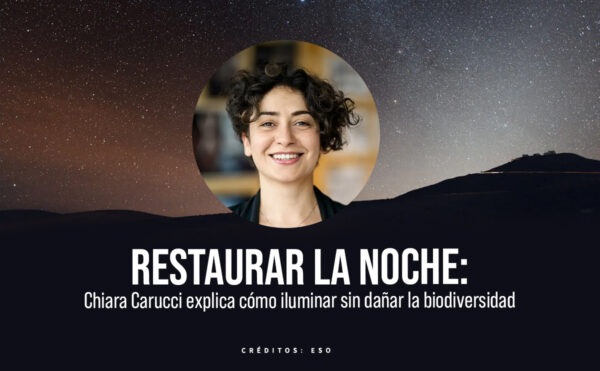
An Italian lighting design professional with over two decades of experience, founder of Noctua studio, and first-ever recipient of the Wildlife Night Watch Award from DarkSky International in 2024, Chiara Carucci has built a career around what it truly means to illuminate well. Speaking from southern Italy, she sat down with Fundación Cielos de Chile to discuss the intersection of her work and the Foundation’s agenda to protect Chile’s night skies.
Chiara Carucci speaks about the night the way someone speaks about a room they know by heart. She is a lighting design professional with over two decades of experience, founder of Noctua studio, and one of the most original voices at the intersection of lighting design, environmental conservation, and cultural heritage. Her work has taken her to collaborate with marine biologists, archaeologists, and ecologists on projects ranging from tourist caves in Italy to natural corridors in Sweden always with the same starting point: poorly designed artificial light causes harm, and that harm can be reduced through rigor, interdisciplinary work, and honesty about the limits of what we know.
At the core of her work is a concept she actively works to counter, one that scientific literature calls the shifting baseline syndrome, or generational environmental amnesia. “Generation after generation, we believe that the state of nature is what we observe”, Carucci explains. “If in this generation nature is degraded, we will not expect to see a better nature. This is our baseline. And our conservation efforts will be dedicated to that degraded nature”.
This phenomenon also applies to our relationship with the night sky. Generations that grow up under polluted skies do not know what is being lost because they never knew it. It is here that Chiara’s work extends from the technical toward the narrative: we must recover memories so that losses become tangible and urgent.
Her Connection to Chile
Carucci is familiar with the work of Fundación Cielos de Chile and celebrated the passage of Chile’s lighting regulation with enthusiasm. For her, working in a country without equivalent regulation, the Chilean experience represents an achievement few nations have reached.
The intersection between her work and the Foundation’s agenda is organic: both stem from the conviction that dark skies, nocturnal biodiversity, and human health are dimensions of the same problem, and that solving it always requires a collective effort. “We cannot protect nature alone”, Carucci concludes. “We always need a team”. She also looks forward to participating in ALAN 2027, the most important international scientific conference on the impacts of artificial light at night, to be held in July of next year in the city of Valparaíso.
Chiara’s Career: Lighting Design for Nocturnal Life
Chiara lives and works in southern Italy, from where she continues to build collaborations with researchers around the world. One of her most emblematic projects involves tourist caves in the Lazio region of Italy, where she worked alongside archaeologists, geologists, and chiropterologists to illuminate the spaces without compromising the bat colonies that inhabit them. The challenge was not only technical: local governors also associated more tourism with more light. Carucci proposed a full mock-up of the cave, walked the routes with local guides, and demonstrated how very little light could create a beautiful atmosphere, tell a story, and attract more visitors. It was this work that earned her the 2024 Wildlife Night Watch Award from DarkSky International, a distinction that recognizes individuals whose decisive actions have protected species sensitive to artificial light at night, whether by restoring natural conditions in protected areas, advancing good lighting policies, or developing education and outreach initiatives on nocturnal biodiversity.
Carucci cites philosopher Taylor Stone to describe her approach: designing for darkness is an act of restoration, for nature, and for people. “I rarely talk about darkness”, she says. “I talk more about the night. The natural night”. Her philosophy on harm encapsulates her values as a practitioner: “We are going to cause harm, but at least let us be conscious of it”. This reinforces a point that Fundación Cielos de Chile consistently promotes: it is not about not illuminating, but about illuminating with an understanding of what is at stake.
All of this comes together in Noctua, the studio Carucci founded around her way of working: bridging heritage and future through sustainable lighting design solutions, one intervention at a time. Noctua operates from the conviction that the problems artificial light creates beyond daytime, for ecosystems, for people, for cultural and natural heritage, are problems that can be solved when approached with rigor, contextual sensitivity, and interdisciplinary teams. The promise is not abstract; it is the result of two decades of projects demonstrating that working with the existing environment, through responsible lighting design, rather than imposing upon it, produces results that are more lasting, more honest, and, why not say it plainly, more beautiful.

Subscribe to our newsletter
Receive relevant information about the skies of Chile every month