


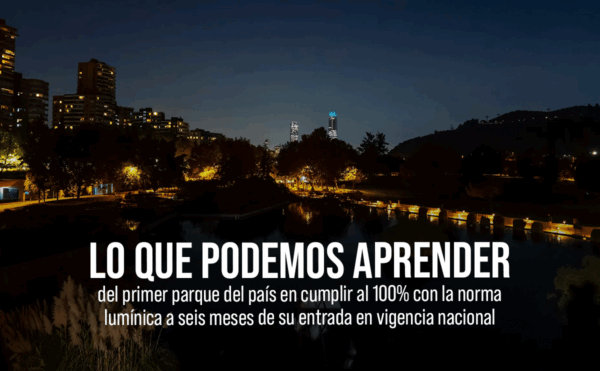
What We Can Learn from the First Park in Chile to Fully Comply with Lighting Regulation

Posteado
Cielos Chile
schedule Wednesday 29 de April
In October 2026, Chile’s lighting regulation will apply nationwide. Vitacura has already shown that compliance is possible, and that doing it well transforms the way we understand public space.
In October of this year, the New Lighting Regulation will begin to apply across the entire national territory. Concretely, this means that all new luminaire projects for exterior public lighting anywhere in Chile will need to meet technical requirements such as limits on blue light emission, directionality of luminous flux, and prior luminaire certification.
Is this feasible? Vitacura already proved it is. In January of this year, the municipality received an honorable mention in the Pedestrian Lighting category at the first edition of the Premio Cielos de Chile for its work at Parque Bicentenario, which became the first park in the country to fully comply with Decreto Supremo N°1 of the Ministry of the Environment before it was mandatory to do so.
A Change of Lights: What the Lighting Regulation Demands
The initiative, led by the Public Lighting team of the Municipality of Vitacura, involved the replacement and expansion of the lighting system, going from 304 to 608 luminaires in pedestrian areas, pathways, entrances, and play areas, with an investment of $891 million Chilean pesos. The results are concrete: 50% less light pollution, elimination of dim zones, and continuous coverage throughout the park.
What is most interesting about the project, however, is not the technical data but the approach behind these decisions. The new luminaires significantly reduce blue light emission, which affects the circadian rhythms of people, fauna, and flora, and lower the color temperature from 4,000 to 2,200 Kelvin, producing warmer, less invasive lighting.
Fundación Cielos de Chile has highlighted this work as proof that getting ahead of regulation is possible. “This is not simply a replacement of luminaires, but a paradigm shift: moving away from asking how much light we want to install, and beginning to ask what the purpose of that light is, where it is directed, and how we are using it”, said Daniela González, Executive Director of Fundación Cielos de Chile.
From the Observatories of the North to a Park in Santiago
The Foundation is not alone in celebrating this milestone. The project was also recognized by the European Southern Observatory (ESO), an institution with a presence in the municipality. “Protecting Chile’s skies is not only a task for the observatories in the north; it is a shared responsibility that begins here, in cities, in neighborhoods, and in parks”, said Itziar de Gregorio-Monsalvo, ESO’s representative in Chile.
The ESO’s perspective is especially relevant. With Chile hosting approximately 40% of the world’s astronomical observation capacity, projects like the Extremely Large Telescope, currently under construction in the Atacama Desert, depend on the lighting regulation being enforced and the country’s skies remaining dark.
What Comes Next: Lighting Regulation Goes National
In October, what Vitacura did as a pioneer will become mandatory for the entire country. The challenge is significant: according to a compliance report recently published by Fundación Cielos de Chile, only 35.5% of luminaires declared before the Superintendency of Electricity and Fuels (SEC) in the Astronomical Areas currently comply with DS N°1. If the enforcement mechanism is not strengthened before that date, the non-compliance observed in the highest-demand zones risks being replicated at a national scale.

Subscribe to our newsletter
Receive relevant information about the skies of Chile every month