


Elqui Valley looks to the sky: Paihuano and Vicuña join forces to promote astro-tourism

Posteado
Cielos Chile
schedule Monday 01 de September
With different histories but a shared sky, Paihuano and Vicuña are moving towards a common strategy that promotes the Elqui Valley as a destination for astro-tourism and sustainability.
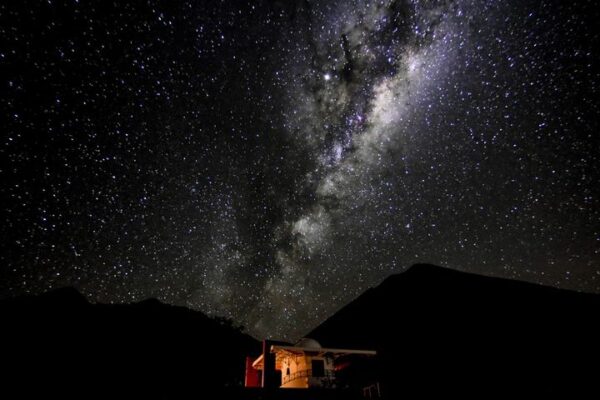
The night sky of the Elqui Valley not only amazes those who observe it, but also drives an unprecedented collaboration between the municipalities of Paihuano and Vicuña. As part of National Astro-tourism Day, both municipalities reaffirmed their commitment to this shared vocation, while moving forward with a strategic alliance that seeks to promote the valley as a coordinated destination, recognized nationally and internationally for the quality of its skies and its astro-tourism experiences.
Paihuano: living under the stars
In Paihuano, the relationship with the starry sky is deep and ancient. Even before astro-tourism was a thing, its inhabitants already valued natural darkness as part of their everyday environment. “The skies are so impressive at night, when there is complete darkness, that it is something the locals are used to seeing. They took it for granted,” said Barbara Swett, manager of the Paihuano Tourism Corporation.
Today, that heritage is transforming into economic opportunity, but also into responsibility. From the Liceo de Excelencia Mistraliano, which offers astronomy workshops, to agencies that combine stargazing with pisco tastings or artistic experiences, Paihuano promotes an intimate connection between community, landscape, and science.
“We take it for granted, but for other people who don’t have the opportunity to see this, it’s important,” added Bárbara. Astronomical tourism in the commune accounts for between 20% and 30% of travel motivations, according to local estimates.
Vicuña: neighbor of the observatories
The development of astro-tourism in Vicuña began more than thirty years ago with the Mamalluca Observatory, a municipal initiative that democratized access to the starry sky. “Today, the astro-tourism offering is very broad,” said Leonardo Alfaro, manager of the Vicuña Tourism Corporation. Other astro-tourism centers have joined this offering, such as Alfa Aldea, the Omega Observatory, the Solaris Observatory, hiking with astronomical observation, and guided tours that integrate nature, science, and local culture.
For the community, astro-tourism is one of its main economic drivers, but Leonardo warns that it is not enough to have privileged skies; it is also key to improve the quality of service and advance international outreach strategies. “Eighty percent of the tourists who come to the region are Chilean and come during seasonal dates. We need to attract foreign tourism throughout the year,” he said.
With the recent launch of the Vera C. Rubin Observatory, which joins the scientific centers already present in the area, Vicuña is once again positioning itself on the global astronomy radar. “The scientific world is eagerly awaiting the images that this telescope will begin to generate. This puts us back at the forefront, and with it, astronomical tourism as well,” Leonardo added.
A strategic alliance
This year’s big step forward has been the collaboration agreement between the two municipalities. Although astro-tourism initiatives had been developed separately, this agreement seeks to consolidate efforts under a shared identity between Paihuano and Vicuña: the Elqui Valley.
“The Elqui Valley is a much better-known brand than Vicuña or Paihuano separately. What we did was sign this agreement to work under that umbrella,” explained Leonardo Alfaro. The agreement includes joint promotion strategies, guide training, tourism product development, and applying for regional funds to improve infrastructure and service quality.
For Bárbara Swett, this agreement marks a turning point. “We are happy today to formalize a political and technical commitment to act together. We want our entrepreneurs to get to know each other, share experiences, and learn from each other. That is also tourism development,” she said.
Both agree that this alliance is not limited to astro-tourism. Wine production, the legacy of Gabriela Mistral, rural tourism, and nature conservation are also shared pillars that strengthen the valley’s identity. “The sky unites us, but so do culture, pisco, rural life, and families. Tourism in the Elqui Valley is much more than just stargazing,” concluded Leonardo.
The importance of protecting the skies
In addition to the above, both authorities agree that the promotion of astro-tourism must be accompanied by education and environmental awareness. “We cannot continue to engage in astro-tourism without teaching the importance of protecting the skies. Light pollution is something that is often overlooked, and a simple misdirected spotlight can

Subscribe to our newsletter
Receive relevant information about the skies of Chile every month