folder
Science
schedule Wednesday 25 de February


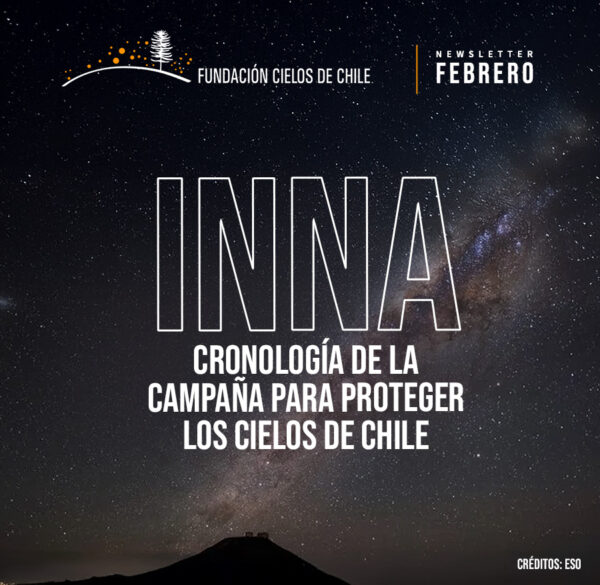
The cancellation of the INNA project marked a turning point in the public discussion about how to promote energy and industrial development that is compatible with the protection of dark skies and the strategic value of astronomy in Chile. The scientific community has emphasized that there is no opposition to clean energy, but rather to its location in areas incompatible with astronomical observation.
The initial plans for the INNA megacomplex contemplated the development of more than 3,000 hectares near the Paranal observatory, just 5 kilometers from the construction site of the future Cherenkov Telescope Array South (CTAO-South), 11 kilometers from the Very Large Telescope (VLT), and 20 kilometers from the site where the Extremely Large Telescope (ELT) is being built—key facilities for world astronomy.
According to a study by the European Southern Observatory (ESO), the megaproject would have increased light pollution by 5% in the ELT skies, by 35% over the VLT, and by more than 50% at CTAO-South. Added to these effects were other critical impacts, such as increased atmospheric turbulence, which could have deteriorated the site’s astronomical visibility conditions by up to 40%.
Under such a scenario, Fundación Cielos de Chile and various astronomical, scientific, and environmental organizations deployed intense joint communication work to explain what was at stake, why light pollution is a critical problem, and how initiatives like INNA represent a risk not only to science but also to ecosystems and people’s health.
On December 20, 2024, the INNA project, promoted by AES Andes, was submitted to the Regional Directorate of the Environmental Assessment Service of the Antofagasta Region. From the outset, its location opened a public debate due to its proximity to some of the world’s main astronomical observatories. In this context, voices from the scientific community early raised in the media the need to carefully evaluate the possible effects of the project on a scientific heritage of global relevance for world astronomy.
ESO, the Chilean Astronomical Society (SOCHIAS), and distinguished national prize winners began to publicly alert about the significant impacts that INNA would produce on the unique conditions of northern Chile. Added to this were the opinions of astronomers such as María Teresa Ruiz and Teresa Paneque, who spread awareness about light pollution threats to the northern skies on their social networks. Thanks to their significant follower base, this action helped massively amplify the message of concern.
In parallel, Fundación Cielos de Chile assumed an active role in this process. Through social networks and outreach actions, the organization invited citizens to participate in the citizen participation process contemplated by Chilean environmental regulations. Through guides and materials, the foundation explained to citizens how to make pertinent and valid observations, promoting informed and effective participation.
Along with this, the president of Fundación Cielos de Chile, Guillermo Blanc, sent a letter to El Mercurio where he addressed international standards on light pollution limits and explained why INNA put at risk the cutting-edge research carried out at the observatories.
Fundación Cielos de Chile and the scientific community made a call to the Environmental Assessment Service to apply early rejection to the project. “It is evident that the project needs serious and profound reformulation—including its relocation—and that provides the necessary guarantees of not generating environmental impact. It would be desirable for State institutions to take early action to prevent perpetuating for years a project that proves not to be viable. Giving that signal of clarity at this stage is a way to reduce uncertainty for all actors involved,” declared Daniela González, executive director of Fundación Cielos de Chile, at this stage.
ESO publishes a technical report that, through transparent and replicable methodologies, demonstrates the irreversible effects of INNA if the project were built.
Concern about the INNA project escalates internationally, and in April 2025, more than 3,000 scientists from around the world sign a letter addressed to President Gabriel Boric requesting the relocation of the project to a distance that would not endanger the darkest skies on Earth.
The citizen participation process closes, reaching more than 700 observations, making it one of the most massive in the history of the Chilean environmental assessment system and evidencing transversal concern for the defense of dark skies.
Thanks to the exceptional quality of its skies, Chile concentrates about 40% of the world’s astronomical observation capacity, and by 2030 it is expected to exceed 60%. To preserve the country’s leadership and protect it from threats, in May 2025, the Association of Universities for Research in Astronomy (AURA), the Giant Magellan Telescope (GMT), ESO, and Las Campanas Observatory signed an agreement to create the Dark Sky Council.
This body has as its central objective to define, coordinate, and monitor a common strategy for the protection of dark skies. Among its functions is articulated work with the Office for the Protection of the Sky Quality of Northern Chile (OPCC) and Fundación Cielos de Chile, as well as the management of resources aimed at implementing concrete actions in the territory. “The quality and darkness of the night sky are fundamental for the scientific operations of our observatories. The preservation of the dark skies of northern Chile is a priority for the signatory institutions, as the continuity of their present and future activities depends on it,” states the signed agreement.
AES Andes requested an extension to respond to citizen observations received for the INNA project.
That same month, a report by Fundación Cielos de Chile revealed that 118 industrial projects planned in areas protected for astronomy had not submitted Environmental Impact Assessments for their light dimension, evidencing regulatory gaps and reinforcing the urgency of updating dark sky protection standards.
“This report shows us that the incorporation of the light variable in environmental assessment is in the process of consolidation, but greater precision is still required to safeguard the night skies of this key area,” stated Daniela González, executive director of the Foundation, to Biobío Chile.
In December 2025, the protection of dark skies explicitly entered the national political agenda. During the last second-round presidential debate, the issue was directly mentioned, consolidating itself as a matter of public interest on a national scale. In response to mention of the possibility that the project’s impacts could be mitigated, Fundación Cielos de Chile publicly reinforced that the INNA project is not mitigable.
That same month, the international community spoke out again regarding the project. Distinguished astronomers from different parts of the world, led by Reinhard Genzel, astronomer at the Max Planck Institute for Extraterrestrial Physics (Germany) and winner of the 2020 Nobel Prize in Physics, signed a letter addressed to the Government of Chile requesting the protection of the dark skies of the Atacama Desert and the relocation of the INNA project.
“We are convinced that economic development and scientific progress can and must coexist for the benefit of all the people of Chile, but not at the irreversible cost of one of Earth’s unique and irreplaceable windows to the universe. We respectfully urge the Government of Chile to request the relocation of the INNA project and to protect Paranal’s delicate environment with appropriate and updated laws,” stated the letter, which you can read here (in spanish).
On January 23, 2026, AES Andes announced that it would not continue with the INNA project, a decision that was formalized on February 6 with the official communication of withdrawal to the Environmental Assessment Service. With this, the project was definitively closed, marking a turning point in the relationship between energy development, public communication, and protection of Chile’s dark skies.
The devastating impact that INNA would have had on the world’s best skies motivated various actors to join this campaign, which had a strong communication component. The different actions achieved wide coverage in Chilean and world media, which allowed carrying the positions of the scientific community to decision-makers.
Social media activation, for its part, contributed to alerting citizens about the effects of this project. The establishment of clear calls to action, such as the invitation to send observations during the citizen participation process, motivated people to get directly involved.
The dissemination of guides for making observations facilitated more people being able to be part of the citizen consultation stage, overcoming the entry barriers that these processes have, which translated into a record participation.
For their part, messages based on scientific evidence and emphasizing the unique characteristics of Chile’s skies for world research resonated with audiences, who identified with them and amplified them through interactions on social networks.
The constant collaborative work between diverse organizations together with citizen support allowed the call to relocate the INNA project to remain in public discussion and strengthen over time. “This campaign showed us that when we unite, it is possible to achieve our objectives. We hope to maintain this unity to continue working for the protection of our dark skies,” highlighted Daniela González, executive director of Fundación Cielos de Chile.
schedule Wednesday 25 de February

schedule Tuesday 02 de September
schedule Friday 23 de May

schedule Tuesday 28 de January

schedule Friday 03 de January
schedule Tuesday 26 de November


Receive relevant information about the skies of Chile every month