

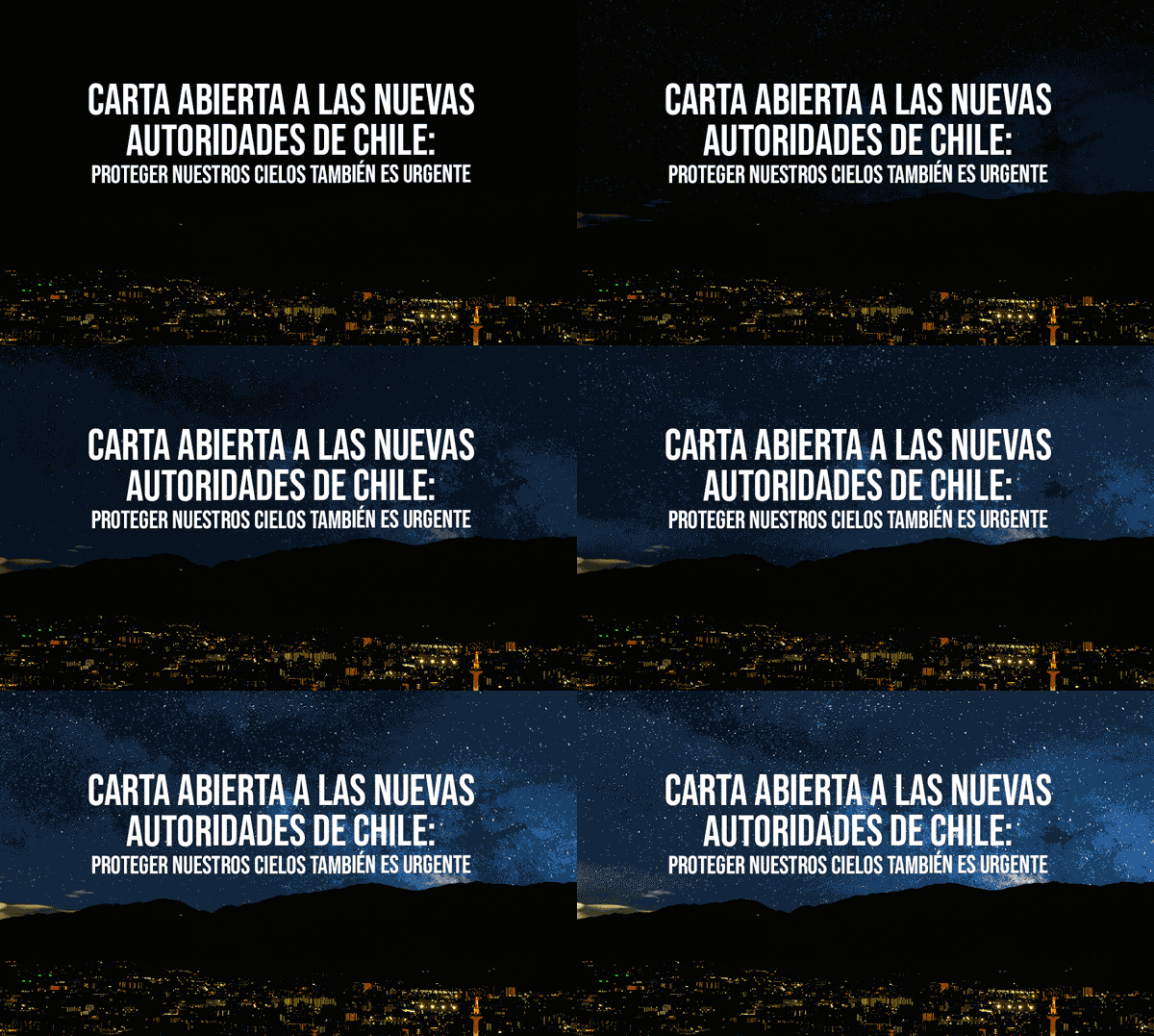
Open letter to Chile’s new authorities Protecting our skies is also urgent

Posteado
Cielos Chile
schedule Thursday 26 de March
Chile is entering a new chapter amid multiple challenges and high public expectations. We know that governing means setting priorities, and that is precisely why we want to put forward a topic that cannot be left in the background: the protection of our dark skies.
When we speak of ecosystems, we speak of interdependence. As Humberto Maturana argued, we do not exist separately from our environment. In Chile, this relationship is powerfully expressed in the connection people have with nature. A recent study published in the scientific journal Ambio ranked Chile among the countries most connected to nature globally, reflecting that this is not only a physical asset, but also a cultural one.
A heritage that transcends governments
In this context, Chile’s dark skies represent a unique heritage. For more than 60 years, the country has taken on a task that transcends any single government: opening its territory to international astronomical observation. This decision has generated investment, development and global recognition, all grounded in an exceptional condition, dark, dry and stable skies, unmatched anywhere on Earth.
Today, Chile hosts nearly 40% of the world’s astronomical observation capacity, a figure that will continue to grow in the coming years. In 2030, Chile will host the General Assembly of the International Astronomical Union. None of this is coincidental: it reflects a sustained national policy and the recognition of a resource that does not run out, but can be lost.
Dark skies as a strategic decision
Light pollution is advancing steadily on a global scale, affecting not only scientific research but also biodiversity and human health. Caring for the night sky is not a luxury: it is a strategic decision. What is at stake is not only the continuity of astronomy, but also our capacity to ask essential questions about the origin of life and the place we inhabit. Looking up at the sky is, in its own way, a means of understanding ourselves.
An opportunity to act
Chile has made progress in this area. The country has an active light pollution regulation, territories recognised as areas of astronomical value, and environmental instruments that safeguard the quality of the dark skies. Within this framework, the recent repeal of the technical guide opens an opportunity to strengthen and update its criteria in line with the best available scientific evidence.
In a context of multiple urgent priorities, this process requires attention and continuity, not because of its technical complexity, but because of its strategic relevance. The foundations are in place, the knowledge exists, and the country has already demonstrated leadership in this field.
There is no need to choose between economic development and protection. Chile’s experience in astronomy shows that both can advance together. Clear regulation does not stop projects: it provides certainty, guides development and protects an asset that sets Chile apart on the global stage.
An invitation to build together
Fundación Cielos de Chile extends an invitation to the new authorities: let us build together a robust, updated and long-term framework that allows this heritage to be preserved.
Whether Chile continues to be an open window to the universe — and a mirror in which humanity recognises itself — depends on the decisions we make today.

Subscribe to our newsletter
Receive relevant information about the skies of Chile every month