folder
Research
schedule Tuesday 02 de September



In recent days, an image of the Trifid and Lagoon nebulae, with a pink glow, has been circulating around the world. It was captured during the first observations of the Vera C. Rubin Observatory and heralds the future of astronomy for the coming decades.
At an event held on Monday, June 23, in Chile, replicated simultaneously in more than 350 celebrations worldwide, the Vera C. Rubin Observatory presented its first images captured from the north of the country. The event was attended by authorities such as the Minister of Science, Technology, Knowledge, and Innovation, Aisén Etcheverry; representatives of the U.S. Embassy; national and international astronomers; and organizations committed to protecting the night sky. The milestone marks the official beginning of the era of astronomical megaprojects that will observe the universe from Chile.
“Chile is an astronomical country,” Minister Etcheverry said during the ceremony. “We couldn’t be more proud of today’s milestone. It is another step in consolidating Chile as an astronomical nation. Astronomy is essential to our scientific development, and these first photographs show how privileged we are to have such skies,” she added.
Construction of the Vera C. Rubin Observatory began in 2015 on Cerro Pachón, in the Coquimbo Region. It has been funded by the National Science Foundation (NSF) and the U.S. Department of Energy (DOE) Office of Science, and is operated by the Association of Universities for Research in Astronomy (AURA).
At the heart of the observatory is an 8.4-meter telescope equipped with the largest digital camera ever built, with 3,200 megapixels. Just to view one of its images in its original size would require more than 400 ultra-high-definition television screens.
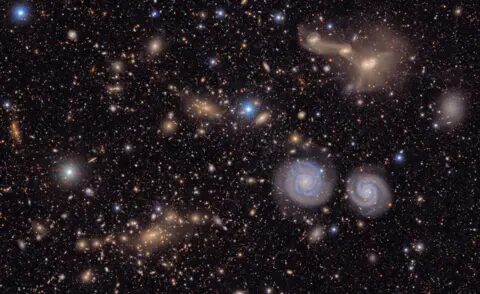
Ten hours of test observations were enough for the Vera C. Rubin to demonstrate its potential: its first images captured millions of stars, galaxies, and more than 2,000 asteroids, some of which had never been seen before. Alejandra Voigt, vice president of AURA, highlighted the observatory’s work: “We are witnessing a new era for global astronomy. The Vera C. Rubin is much more than a telescope; it is a new way of approaching what we have never seen before.”
During the presentation, it was emphasized that the success of the project is also a recognition of the quality of the Chilean sky. From the parallel headquarters in the United States, the National Academy of Sciences and other institutions insisted that the country plays a leading role in global astronomy. However, this leadership position faces a growing threat: light pollution, which has increased in areas near observatories.
The vice president of AURA emphasized the role that observatories play in protecting the country’s dark skies. “Currently, caring for the skies is an essential part of environmental impact assessments in Chile, but we must continue to improve regulations and raise public awareness. It is important that all observatories work together, because we know that together we are stronger,” she said.
The Cielos de Chile Foundation appreciated that this type of scientific advance highlights the urgency of protecting dark skies. “What we saw today are amazing images of the universe. But for the Vera Rubin Observatory to fulfill its mission, it is essential to continue protecting the dark skies, so that all the mysteries of the universe can be solved from this privileged territory,” said Daniela González, executive director of the foundation.
The Vera C. Rubin Observatory will begin full scientific operation in late 2025. The volume of data it generates is expected to exceed that of all current optical observatories in the world combined. But its mission is not only to expand scientific knowledge, but also to democratize it. In line with this, the first images were shared with planetariums, museums, schools, and universities around the world, in a firm commitment to open knowledge, shared wonder, and the inspiration of new generations of scientists.
In addition, the data captured by Vera C. Rubin will be available free of charge to the astronomical community. It will be delivered already processed, so that anyone with basic knowledge can explore it, analyze it, and contribute to the advancement of knowledge from Chile.
schedule Tuesday 02 de September
schedule Tuesday 02 de September
schedule Wednesday 28 de August

Receive relevant information about the skies of Chile every month